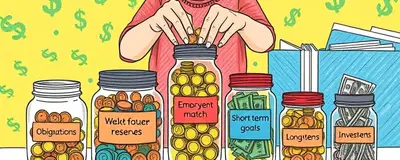
Investing can feel daunting, but with a clear roadmap anyone can grow wealth over time. Embrace your financial journey today with confidence and a simple plan.
What Investing Means
Investing involves committing money to assets like stocks, bonds, mutual funds, or ETFs with the expectation of future income or growth. Unlike a savings account, investments can fluctuate in value and returns are not guaranteed.
It’s important to distinguish between related concepts:
- Saving: Preserving money and maintaining liquidity for short-term needs.
- Investing: Accepting price fluctuations to pursue long-term growth.
- Speculation: Taking substantial risk without a durable investment rationale.
Investing is generally most appropriate for money that isn’t needed immediately.
Why People Invest
Whether aiming for retirement, a down payment on a home, or funding a child’s education, every investor starts with a goal. Common objectives include:
- Building a retirement nest egg.
- Saving for a home purchase.
- Funding education expenses.
- Achieving financial independence.
- Protecting against inflation over the long term.
Define your objective clearly by estimating how much money you’ll need and when. This clarity helps you define a clear investment goal and choose the right strategy.
Aligning Goals with Time Horizons
Your time horizon influences how much volatility you can absorb. The following table offers general guidelines:
Financial Preparation Before Investing
Investing should complement, not replace, a solid financial foundation. Consider these preparatory steps:
- Build an emergency reserve in cash to cover unexpected expenses.
- Address high-interest debt, such as credit-card balances.
- Capture employer retirement plan contributions and any matching offer.
- Ensure you have appropriate insurance—health, disability, property, liability.
These measures help you avoid using funds needed for essentials and reduce the risk of forced withdrawals during market downturns.
The Three Questions Every Beginner Should Answer
Before selecting investments, answer:
1. What am I investing for? Write down your goal, target amount, date needed, and contribution capacity. Imagine how you would feel if the investment declined.
2. When will I need the money? Your time horizon dictates how much volatility you can tolerate. Money needed soon has less recovery time; distant goals can absorb more fluctuations.
3. How much risk can I tolerate? Assess both your emotional reaction to losses and your financial ability to endure declines without jeopardizing your goal. Never chase higher returns at the cost of unnecessary risk.
Core Investment Choices
Once your goals, timeline, and risk profile are clear, explore these main asset classes:
Stocks: Shares represent company ownership. They offer potential for high long-term growth but can be volatile. Key risks include market crashes, sector downturns, and company failures.
Bonds: Debt instruments issued by governments or corporations. Investors earn interest and principal repayment, subject to credit and interest-rate risk. Longer maturities typically carry greater sensitivity to rate changes.
Cash and cash equivalents: Savings deposits, money-market funds, Treasury bills, or CDs provide stability and liquidity but may not keep pace with inflation over extended periods.
Mutual funds and ETFs: Pooled investments that offer diversification. Mutual funds trade at end-of-day NAV; ETFs trade throughout the day. Review each fund’s focus and fees to ensure broad diversification.
Target-date funds: Single-fund solutions that automatically adjust asset allocation toward a target year. Examine their glide path, fee structure, and whether they align with your investment comfort level.
Diversification: The Most Important Beginner Concept
Diversification means spreading investments across different assets, industries, and geographies. This strategy can reduce the impact of a poorly performing security or sector.
Remember:
- Diversification cannot eliminate market risk.
- It may smooth volatility but won’t guarantee profits.
- A concentrated portfolio can increase risk sharply.
Asset allocation—the mix of stocks, bonds, and cash—should be tailored to your specific goal, time horizon, and risk tolerance rather than following a one-size-fits-all model.
Compound Growth and Regular Contributions
Compound growth occurs when investment returns are reinvested to generate additional earnings. Over time, this can create exponential growth.
A simple future-value formula for recurring contributions is:
FV = C × ((1 + r)^n – 1) / r
where C is the regular contribution, r is the annual return rate, and n is the number of years.
For example, contributing $200 per month for 30 years at an average 7% return (compounded monthly) would involve $72,000 in contributions. Hypothetically, this amount could grow to around $244,000 before fees, taxes, and inflation.
This illustration is not a forecast; actual returns vary and investments can lose value. Yet, consistent contributions harness the power of time and compounding to build wealth.
Starting small, staying disciplined, and reviewing your plan periodically will help you navigate the ups and downs of markets. By defining clear goals, choosing diversified and low-cost investments, and maintaining a long-term perspective, you can turn your first steps into a steady journey toward financial growth. Remember, you don’t need to predict the market or begin with a large sum—just a solid plan and the patience to see it through.